

Would love to get your thoughts on "Ultimate Fundamentals: Forehand"
-
-
I may just not have read enough yet, but I would like to see more how stuff in addition to the what. Basically practical application and how to practice things you mention. In addition I would like to see stuff on how to practice defectively in general also. Keep in mind I'm just nitpicking-the site is great but there is always room for improvement.Last edited by eaglesburg; 08-03-2015, 02:50 PM. -
Fair enough. But you will find a large amount of that as you work through the site. Look at my serve series in the teaching systems.
Here is the big picture:
https://www.tennisplayer.net/article...-mental-games/Comment
-
This site has lots of great stuff. It's out there waiting to be explored, discovered and dissected. Start reading.
Here are a few that may help...
Match preparation
https://www.tennisplayer.net/article/match-preparation/
Play The Way You Practice
https://www.tennisplayer.net/article...ay-i-practice/
Anything on the forehand in the Advanced Tennis Section
https://www.tennisplayer.net/articles/
Kyle LaCroix USPTA
Boca RatonComment
-
Good building block
The unit turn must also be accompanied with correct footwork. The right foot for righthanders must be part of the unit turn and be behind/to the side of the ball for the other components of the turn not to breakdown. Also the coming out of the turn to hit the ball will differ according to grip and swingpatterns. Looking forward to seeing how this is explainedComment
-
S,
There are a lot of potential footwork patterns that go with the body turn, including step outs, pivots, reverse pivots, backwards steps, backwards crossover steps, drop steps, occasional shuffle steps. And probably some I forgot right now...They will all work so long as the facilitate the turn. Generally they coordinate with the direction the player is moving and the distance to the ball.
There is some discussion of it here:
https://www.tennisplayer.net/article...d-preparation/
Also peruse the footwork articles, from the simplest step out model from Bob Hansen to the patterns analysis by Pat Daugherty and David Bailey. Michael Friedman's article on the keys to quickness is also worth it.Last edited by John Yandell; 08-06-2015, 07:12 PM.Comment
-
Internal shoulder rotation
I think shoulder external rotation, while racquet is swung forward, reversing to internal rotation around contact is a key that is not talked about very much. John does mention it in one of his articles or videos saying, "the inside of the forearm should point up to the sky". It's an absolute must and without it you're left forcing the racquet head to rotate up and over.
Many people swing through with the elbows pointing backwards - stroke-killing mistake.
JonLast edited by jdcremin; 08-07-2015, 09:48 AM.Comment
-
Hand Height at Maximum Extension
I've always been curious. Regarding the height of the hand at maximum extension. John always talks about it being at eye level. What's the importance of it being at eye level?
I ask because I notice from watching a lot of the top juniors here at home in Ireland (we play on artificial grass which is low bouncing, the ball skids, it doesn't take topspin very well, we play when it's raining (it pretty much sucks), that people tend to play very flat and with no real trajectory), and when I watch them, the girls in particular don't seem to reach maximum extension with their hand at eye level, whereas, maybe the ones who came up through the national program and had access to indoor hard, it's a little more solid and they reach this position a lot better.
A lot of the time you see the hand lower at maximum extension. Do you think this might affect the arc?
Ironically enough, seeing as I grew up on the artificial grass, often playing in lashing rain, and on low bouncing, skidding courts I hit it very very flat, and out of interest got some videos of me hitting in Spain this week on a hard court, and most of the time I have this low position at extension as well. Interestingly, the best forehand I hit which is shown, my hand was higher. There was a lot more spin and arc on that one.
So I'm beginning to think that the height of the hand is relevant to the type of spin/ trajectory of the shot? Because I see it happening an awful with our better players at home in our club. What do you guys think?
Have attached one or two examples to show you what I mean.
Below:
[IMG]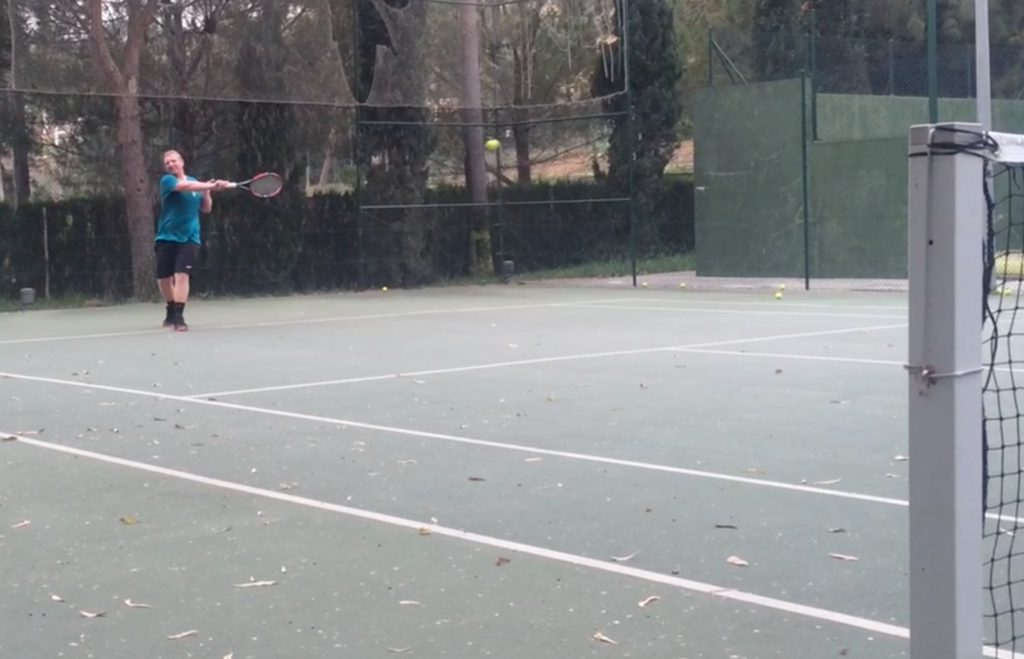 [/IMG]
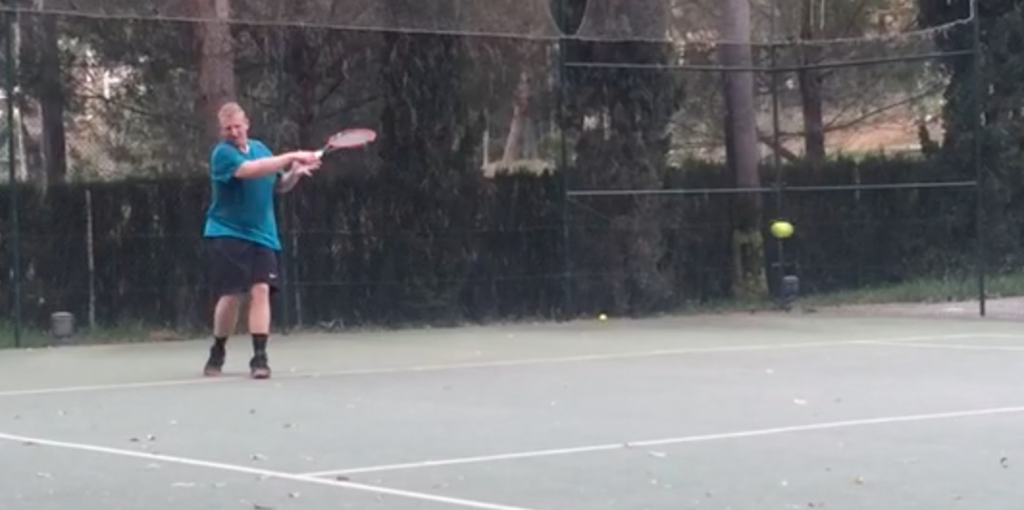
At eye level:
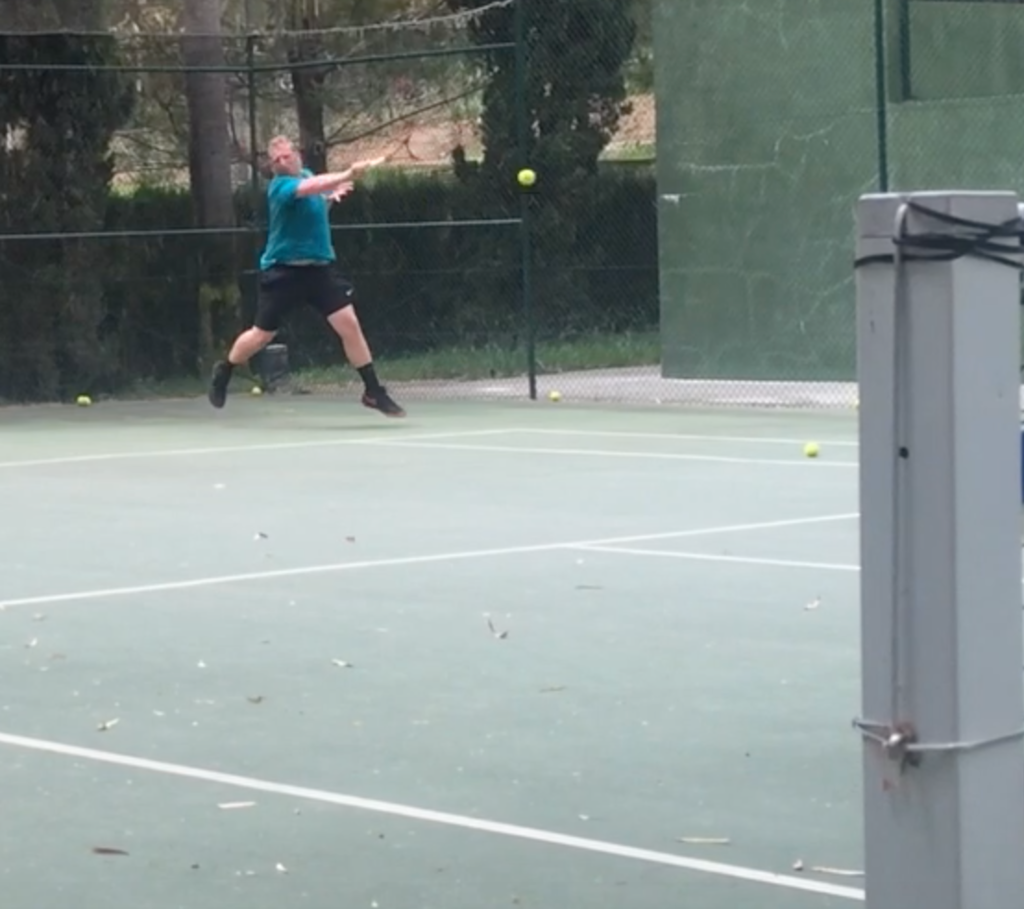
Comment
-
If I had to guess I would say that you are on the right track. I would bet that the higher the extension the more spin and arc and vice versa.Comment
-
A couple of other fundamentals to the modern forehand exhibited by Federer, Nadal and Djokovic
The racquet strings face the court as it drops into the lag
The racquet head is below the level of the wrist as the forward component of the swing begins, at the level of the wrist at the moment of impact (with the hitting face perpendicular to the ground) and above the wrist at follow through (again with the hitting face pointing towards the ground as the racquet arcs through its follow through - the racquet is facing the ground when it is pointing towards the opponents back fence)Comment
-
Andrew,
Great post. The issue of the dog pat is interesting. If you study enough clips you learn that it isn't constant across shots even for the same player. I think it's a consequence not a fundamental:
https://www.tennisplayer.net/article...th-of-the-dog/Comment


Comment